Descriptive immune repertoire statistics
Description

A family of functions that summarise the basic structure of immune repertoires. These summaries help you check data quality, compare samples, and describe chain counts, sequence lengths, and gene usage before more detailed analyses.
Available functions
The following methods are available.
1) Chain counts (airr_desc_chains). Count
V(D)J chains in each repertoire, optionally grouped by locus. Use this
method to check capture depth, compare library sizes, examine
TRA/TRB/IGH balance, and identify locus-specific loss or
over-representation.
2) Sequence-length distribution
(airr_desc_lengths). Count sequences of each
length per repertoire, optionally grouped by annotation columns. Use
this method to describe CDR3 length distributions, detect possible
library preparation bias, compare groups, and create length-based
features.
3) Gene usage (airr_desc_genes). Count
V(D)J gene segments per repertoire, optionally grouped by locus. The
method can count unique receptors or sum barcode/UMI counts. Use it to
compare gene usage between groups, identify unusual gene patterns, and
create repertoire-level features.
Usage
airr_desc_chains(
  idata,
  locus_col = NA,
  autojoin = getOption(IMMUNARCH_AUTOJOIN_OPTION, IMMUNARCH_AUTOJOIN_DEFAULT),
  format = c("long", "wide")
)

airr_desc_lengths(
  idata,
  seq_col = "cdr3_aa",
  by = NA_character_,
  autojoin = getOption(IMMUNARCH_AUTOJOIN_OPTION, IMMUNARCH_AUTOJOIN_DEFAULT),
  format = c("long", "wide")
)

airr_desc_genes(
  idata,
  gene_col = "v_call",
  level = c("receptor", "barcode"),
  by = NA_character_,
  autojoin = getOption(IMMUNARCH_AUTOJOIN_OPTION, IMMUNARCH_AUTOJOIN_DEFAULT),
  format = c("long", "wide")
)
Arguments
idata |
An immundata::ImmunData object. |
locus_col |
A single character string, NA, or NULL.
The default, NA, uses the canonical locus column when it is
available. Supply NULL to combine loci, or a column name to
group by that column. |
autojoin |
Logical. If TRUE, join repertoire metadata by the schema repertoire
id. Change the default behaviour by calling
options(immunarch.autojoin = FALSE). |
format |
String. One of "long" ("long" tibble with
imd_repertoire_id, facet columns, and value;
useful for visualizations) or "wide" (wide/unmelted table
of features, with each row corresponding to a specific repertoire / pair
of repertoires; useful for Machine Learning). |
seq_col |
A single character string naming the sequence column. |
by |
A character vector, NA, or NULL. The
default NA automatically groups by the canonical
locus column when it is available. Supply NULL
to pool loci, or a character vector to group by and return those columns
explicitly. |
gene_col |
A single character string naming a gene-segment column calls (e.g.,
"v_call", "d_call", "j_call",
"c_call"). Default is "v_call". |
level |
A single character string: "receptor" or
"barcode". If "receptor" (default), the
function counts unique receptors (one per receptor ID)
that carry a given gene segment. If "barcode", the function
sums counts (e.g., cells/UMIs) per gene segment using
the column defined by immundata::imd_schema("count"). |
Value
1) Chain counts (airr_desc_chains)
A tibble with columns:
-
imd_repertoire_id– internal repertoire identifier - repertoire-summary columns carried from
idata, such asn_barcodesandn_receptors -
locus– TRA, TRB, IGH, ...;NAwhen locus grouping is disabled -
n_chains– number of chains
2) Sequence-length distribution (airr_desc_lengths)
A tibble with columns:
-
imd_repertoire_id– internal repertoire identifier - grouping columns requested through
by(for example,locus) -
seq_len– lengths of sequences -
n– number of sequence rows -
prop,pct– proportion and percentage within each repertoire and combination of grouping columns
3) Gene usage (airr_desc_genes)
A tibble with columns:
-
<gene_col>- the gene segment value (e.g., V gene) -
imd_repertoire_id- internal repertoire identifier - grouping columns requested through
by(for example,locus) -
n- the measure:- if
level = "receptor": number of receptors carrying the gene segment within the grouping - if
level = "barcode": sum of counts across receptors for the segment
- if
Visualisation
All three airr_desc_*() results
can be passed directly to vis(). With autojoin =
TRUE (the default), repertoire summaries and user metadata are
included in the result and can be selected by the plotting arguments.
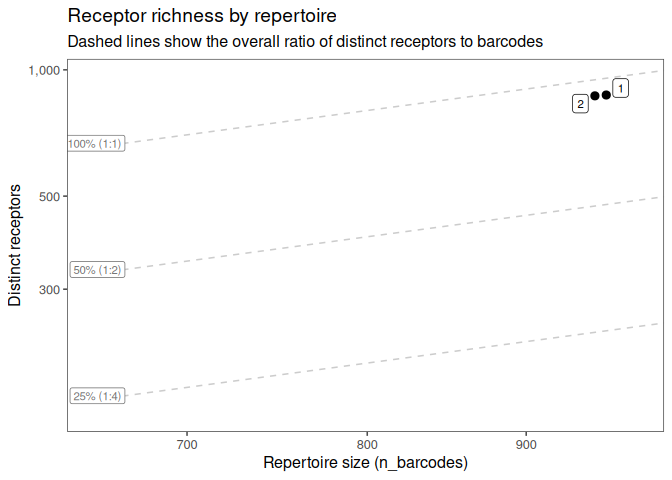
1) Chain counts (airr_desc_chains)
vis() plots one point per repertoire, with
n_barcodes on the x-axis and n_receptors on
the y-axis. Both axes use log scales. Dashed lines mark overall
receptor-to-barcode ratios of 100%, 50%, and 25%. Locus-specific rows
share the same repertoire totals, so they appear as one point. The plot
accepts:
-
labelselects one or more columns for point labels; the default isimd_repertoire_id. -
colourcolours points by a repertoire metadata column.fillis accepted as an alias for existing calls. -
titlereplaces the default plot title.
For single-cell data, n_barcodes is the observed cell
count; for bulk data, it is total abundance. The ratio shows
repertoire-level richness, not how many receptors occur within each
barcode.
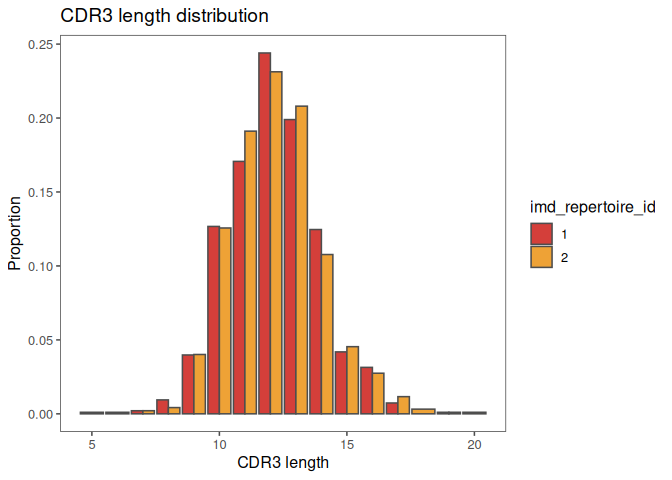
2) Sequence-length distribution (airr_desc_lengths)
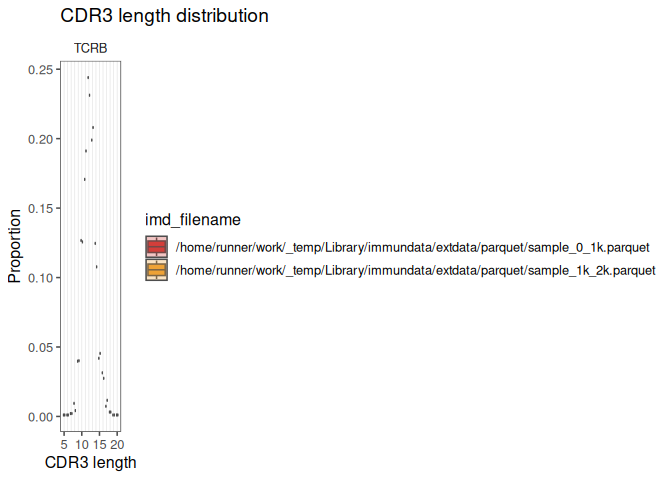
vis() plots seq_len on the x-axis and
prop on the y-axis, filled by repertoire. Set
fill to a metadata or grouping column to compare groups
with box-and-violin distributions. facet accepts one column
for a wrapped layout or two columns for a facet grid; dir =
"h" or dir = "v" controls the wrapping direction.
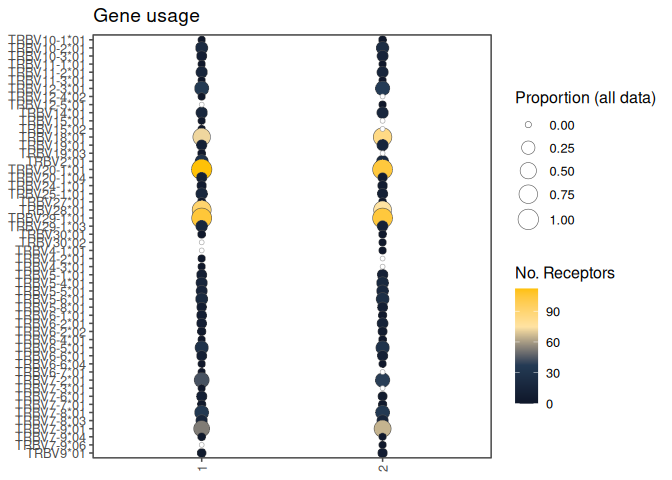
3) Gene usage (airr_desc_genes)
vis() produces a dot plot with gene segments as rows,
repertoires as columns, and n mapped to dot size and
colour. Use row to select the gene column, col
to select repertoire or metadata columns, and value to
select the numeric measure. size_max_mm controls the
largest dot; row_order and col_order set the
display order.
See Also
immundata::ImmunData
Examples
library("immunarch")

# Limit the number of threads used by the underlying DB for this example.
# Generally, you should NOT do this in your session.
db_exec("SET threads TO 1")

# Load example data.
immdata <- get_test_idata()

#
# Count chains in each repertoire.
chain_stats <- airr_desc_chains(immdata)

# Repertoire size versus distinct receptor count
vis(chain_stats)
# Label and colour by repertoire metadata when those columns are available.
# vis(chain_stats, label = "Sample", colour = "Tissue")


#
# Calculate CDR3 length distributions.
length_stats <- airr_desc_lengths(immdata)

# Default: CDR3 length proportions by repertoire
vis(length_stats)
# Compare distributions between repertoires and split them by locus.
vis(length_stats, fill = "imd_filename", facet = "locus")
#> # A tibble: 28 × 7
#>    imd_repertoire_id locus seq_len     n    prop    pct imd_filename
#>  *             <int> <chr>   <dbl> <int>   <dbl>  <dbl> <chr>
#>  1                 1 TCRB        5     1 0.00105  0.105 /home/runner/work/_temp…
#>  2                 1 TCRB        6     1 0.00105  0.105 /home/runner/work/_temp…
#>  3                 1 TCRB        7     2 0.00209  0.209 /home/runner/work/_temp…
#>  4                 1 TCRB        8     9 0.00942  0.942 /home/runner/work/_temp…
#>  5                 1 TCRB        9    38 0.0398   3.98  /home/runner/work/_temp…
#>  6                 1 TCRB       10   121 0.127   12.7   /home/runner/work/_temp…
#>  7                 1 TCRB       11   163 0.171   17.1   /home/runner/work/_temp…
#>  8                 1 TCRB       12   233 0.244   24.4   /home/runner/work/_temp…
#>  9                 1 TCRB       13   190 0.199   19.9   /home/runner/work/_temp…
#> 10                 1 TCRB       14   119 0.125   12.5   /home/runner/work/_temp…
#> # ℹ 18 more rows
#> # A tibble: 28 × 6
#>    imd_repertoire_id seq_len     n    prop    pct imd_filename
#>  *             <int>   <dbl> <int>   <dbl>  <dbl> <chr>
#>  1                 1       5     1 0.00105  0.105 /home/runner/work/_temp/Libra…
#>  2                 1       6     1 0.00105  0.105 /home/runner/work/_temp/Libra…
#>  3                 1       7     2 0.00209  0.209 /home/runner/work/_temp/Libra…
#>  4                 1       8     9 0.00942  0.942 /home/runner/work/_temp/Libra…
#>  5                 1       9    38 0.0398   3.98  /home/runner/work/_temp/Libra…
#>  6                 1      10   121 0.127   12.7   /home/runner/work/_temp/Libra…
#>  7                 1      11   163 0.171   17.1   /home/runner/work/_temp/Libra…
#>  8                 1      12   233 0.244   24.4   /home/runner/work/_temp/Libra…
#>  9                 1      13   190 0.199   19.9   /home/runner/work/_temp/Libra…
#> 10                 1      14   119 0.125   12.5   /home/runner/work/_temp/Libra…
#> # ℹ 18 more rows
#
# Calculate V gene usage from receptor counts.
gene_stats <- airr_desc_genes(
  immdata,
  gene_col = "v_call",
  level = "receptor"
)

# Default: genes by repertoire, with counts mapped to dot size and colour
vis(gene_stats)
# Compare gene usage across repertoires and loci.
vis(
  gene_stats,
  row = "v_call",
  col = c("imd_filename", "locus"),
  value = "n",
  size_max_mm = 5
)
# V gene usage by summed cell/UMI counts (if a count column is present)
airr_desc_genes(immdata, gene_col = "v_call", level = "barcode")
#> # A tibble: 92 × 5
#>    v_call      imd_repertoire_id locus     n imd_filename
#>  * <chr>                   <int> <chr> <dbl> <chr>
#>  1 TRBV20-1*01                 1 TCRB    123 /home/runner/work/_temp/Library/im…
#>  2 TRBV29-1*01                 1 TCRB    122 /home/runner/work/_temp/Library/im…
#>  3 TRBV28*01                   1 TCRB     97 /home/runner/work/_temp/Library/im…
#>  4 TRBV18*01                   1 TCRB     86 /home/runner/work/_temp/Library/im…
#>  5 TRBV7-9*01                  1 TCRB     60 /home/runner/work/_temp/Library/im…
#>  6 TRBV7-2*01                  1 TCRB     44 /home/runner/work/_temp/Library/im…
#>  7 TRBV7-8*01                  1 TCRB     36 /home/runner/work/_temp/Library/im…
#>  8 TRBV12-3*01                 1 TCRB     36 /home/runner/work/_temp/Library/im…
#>  9 TRBV10-2*01                 1 TCRB     32 /home/runner/work/_temp/Library/im…
#> 10 TRBV6-5*01                  1 TCRB     28 /home/runner/work/_temp/Library/im…
#> # ℹ 82 more rows
# Split by locus (TRA/TRB/... if locus column exists)
airr_desc_genes(immdata, gene_col = "v_call", level = "receptor", by = "locus")
#> # A tibble: 92 × 5
#>    v_call      imd_repertoire_id locus     n imd_filename
#>  * <chr>                   <int> <chr> <int> <chr>
#>  1 TRBV20-1*01                 1 TCRB    112 /home/runner/work/_temp/Library/im…
#>  2 TRBV29-1*01                 1 TCRB    105 /home/runner/work/_temp/Library/im…
#>  3 TRBV28*01                   1 TCRB     91 /home/runner/work/_temp/Library/im…
#>  4 TRBV18*01                   1 TCRB     72 /home/runner/work/_temp/Library/im…
#>  5 TRBV7-9*01                  1 TCRB     53 /home/runner/work/_temp/Library/im…
#>  6 TRBV7-2*01                  1 TCRB     43 /home/runner/work/_temp/Library/im…
#>  7 TRBV12-3*01                 1 TCRB     36 /home/runner/work/_temp/Library/im…
#>  8 TRBV7-8*01                  1 TCRB     35 /home/runner/work/_temp/Library/im…
#>  9 TRBV6-5*01                  1 TCRB     28 /home/runner/work/_temp/Library/im…
#> 10 TRBV2*01                    1 TCRB     27 /home/runner/work/_temp/Library/im…
#> # ℹ 82 more rows
#> # A tibble: 92 × 4
#>    v_call      imd_repertoire_id     n imd_filename
#>  * <chr>                   <int> <int> <chr>
#>  1 TRBV20-1*01                 1   112 /home/runner/work/_temp/Library/immundat…
#>  2 TRBV29-1*01                 1   105 /home/runner/work/_temp/Library/immundat…
#>  3 TRBV28*01                   1    91 /home/runner/work/_temp/Library/immundat…
#>  4 TRBV18*01                   1    72 /home/runner/work/_temp/Library/immundat…
#>  5 TRBV7-9*01                  1    53 /home/runner/work/_temp/Library/immundat…
#>  6 TRBV7-2*01                  1    43 /home/runner/work/_temp/Library/immundat…
#>  7 TRBV12-3*01                 1    36 /home/runner/work/_temp/Library/immundat…
#>  8 TRBV7-8*01                  1    35 /home/runner/work/_temp/Library/immundat…
#>  9 TRBV6-5*01                  1    28 /home/runner/work/_temp/Library/immundat…
#> 10 TRBV2*01                    1    27 /home/runner/work/_temp/Library/immundat…
#> # ℹ 82 more rows